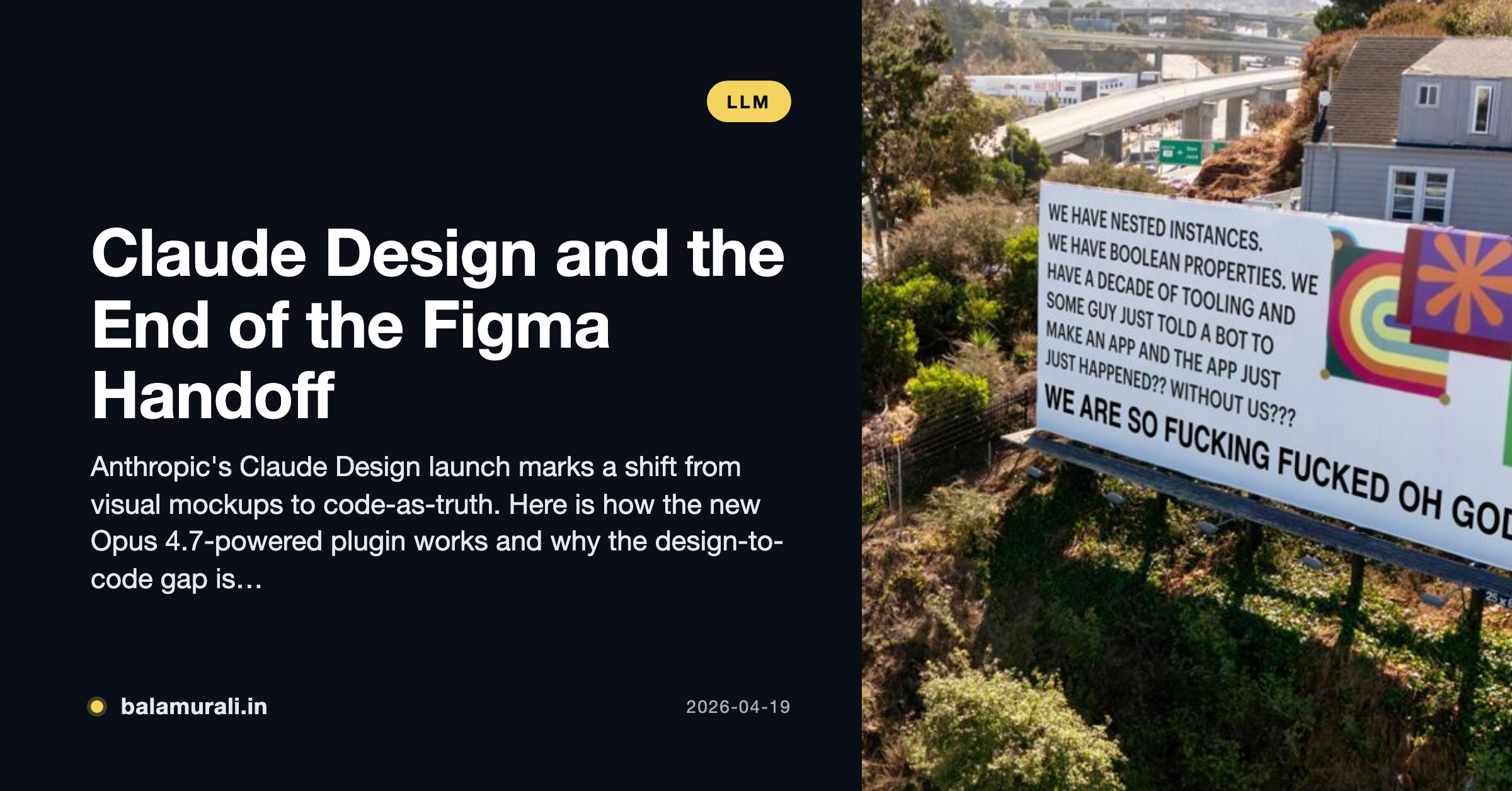
Anthropic just launched Claude Design, and the design world is having a collective existential crisis. It’s not just another “text-to-UI” toy; it’s a signal that the “source of truth” is moving from visual canvases back to the codebase where it belongs.
On April 17, 2026, Anthropic Labs shipped Claude Design, a plugin for the Claude Cowork ecosystem that generates polished design systems, interactive prototypes, and marketing assets directly from prompts or existing codebases. The launch was punctuated by a high-drama corporate move: Anthropic CPO Mike Krieger quietly resigned from Figma’s board just three days prior. When the plugin went live, Figma’s stock slid roughly 5–7% in a single session. The message to the market was clear: the first-draft layer of the design stack is being swallowed by the LLM.
The Death of the “Lossy Approximation”
For the last decade, Figma has been the undisputed king of the design-to-dev workflow. But as practitioners on Hacker News have pointed out, Figma’s victory came with a hidden technical debt. By creating a proprietary, largely-undocumented format, Figma effectively excluded itself from the massive training sets that powered the current generation of LLMs.
Models like the new Claude Opus 4.7 were trained on code—CSS, React, Tailwind, and JSON—not on Figma’s baroque system of nested components, library swaps, and aliased variables. This created a gap where designers were essentially “painting watercolors of a pot” instead of throwing the clay. Claude Design attempts to bypass this by making code the primary medium. Instead of a designer building a component sketch for three days, a product lead can now describe a page and receive a structured, interactive prototype in minutes that already understands the project’s existing brand and component logic.
Technical Implementation: How Claude Design Works
Claude Design isn’t a simple image generator. It is a full-featured plugin with its own slash commands and a dedicated editing surface. It runs on the Claude Opus 4.7 vision model, which Anthropic claims is specifically tuned for visual-to-code reasoning.
According to the launch documentation, the tool can ingest:
- Plain-language prompts: “Build a pricing page for a B2B data product, blue/green palette, enterprise feel.”
- Existing codebases: It infers your component library, type system, and brand guidelines directly from your repo.
- Visual references: You can upload a Figma export, PDF, or even a screenshot of a competitor’s site.
- Voice briefs: Integration with the Cowork Productivity plugin allows for transcript-to-design workflows.
Unlike static image generators, Claude Design returns editable artifacts. You can comment on individual elements, use sliders to adjust spacing or typography, and step backward to regenerate specific components without destroying the rest of the layout. Crucially, it follows an “approval-first” workflow: nothing writes to your repo or design files unless you explicitly accept the change.
The Shift to Ontological Truth
This launch accelerates a broader industry shift from aspirational design (what we hope the UI looks like) to ontological truth (what actually exists in production). In a code-first world, the design system is defined by Design Tokens stored in JSON or YAML repositories.
For teams looking to implement this “code-as-truth” model, the technical architecture usually follows a three-tiered hierarchy:
- Primitive Tokens: Raw values like hex codes (
#FF0000) or spacing units (16px). These are platform-agnostic. - Semantic Tokens: These assign meaning to primitives (e.g.,
color-text-primarymaps toblue-800). This is where the magic happens for dark mode or multi-brand theming. - Component Tokens: High-level tokens specific to one element (e.g.,
button-primary-background).
Tools like Style Dictionary or Theo are then used to transform these central JSON files into platform-specific code (CSS variables for web, XML for Android, Swift for iOS). This ensures that a single change in the token repo propagates everywhere, eliminating the “design drift” that plagues traditional handoffs.
Competitive Landscape: Figma vs. Claude
Figma isn’t sitting still. They recently introduced the Model Context Protocol (MCP) server, which allows agentic coding tools like Cursor or VS Code to pull structured design data directly from Figma files. This is a defensive play to keep Figma relevant as the “source of truth” even when the actual building happens in an IDE.
However, the tension remains. Developers are increasingly vocal on Reddit about the cost of maintaining parity. When a component exists in code but not in Figma, the design tool becomes a liability rather than an asset. Claude Design’s approach—generating the design from the code—reverses this relationship. It treats the design tool as a visual projection of the codebase, rather than a separate entity that needs to be synced.
Community Sentiment: Force Multiplier or “Slop”?
Reception among practitioners is polarized. On Reddit’s r/ClaudeAI, many see it as a “massive force multiplier,” particularly for developers who can now ship professional-grade UI without a dedicated design hire. There is a sense of awe at the speed: one user reported creating 175 variables and packaging them into a reusable MCP skill in a single afternoon.
On the other hand, senior designers are sounding the alarm on the “Homogenization Trap.” Critics on Hacker News argue that because LLMs are trained on existing patterns, they tend to produce a “popular status-quo” aesthetic. Some have even labeled the output as “design slop”—visually polished but lacking the functional clarity and intuitive leaps that a human designer provides. There is also a technical concern regarding “visual blindness”; some reviewers noted that while Claude can generate clean code, it occasionally makes decisions based on code structure rather than how the final visual output actually looks to a human user.
Takeaways for Engineering Teams
- Audit your Handoff: If your team spends more than 20% of its time “syncing” Figma to React, you are a prime candidate for a code-first transition.
- Adopt Semantic Tokens: Move your design variables into a centralized JSON/YAML repository. This is the only way to make your design system “legible” to agents like Claude.
- Vertical Slice Architecture: Organize your code by feature rather than by layer. This maximizes context isolation, making it easier for AI agents to understand and modify specific UI components without side effects.
- The Designer’s New Role: The role is shifting from “pixel pusher” to “system architect.” Designers who can manage token logic and audit AI-generated outputs will be the ones who thrive in the agentic era.
- Watch the Drift: AI-generated code can lead to a 41% increase in technical debt if not governed. Use Claude Design for the “first draft,” but keep a human in the loop for the final architectural review.
Full analysis: Anthropic Labs