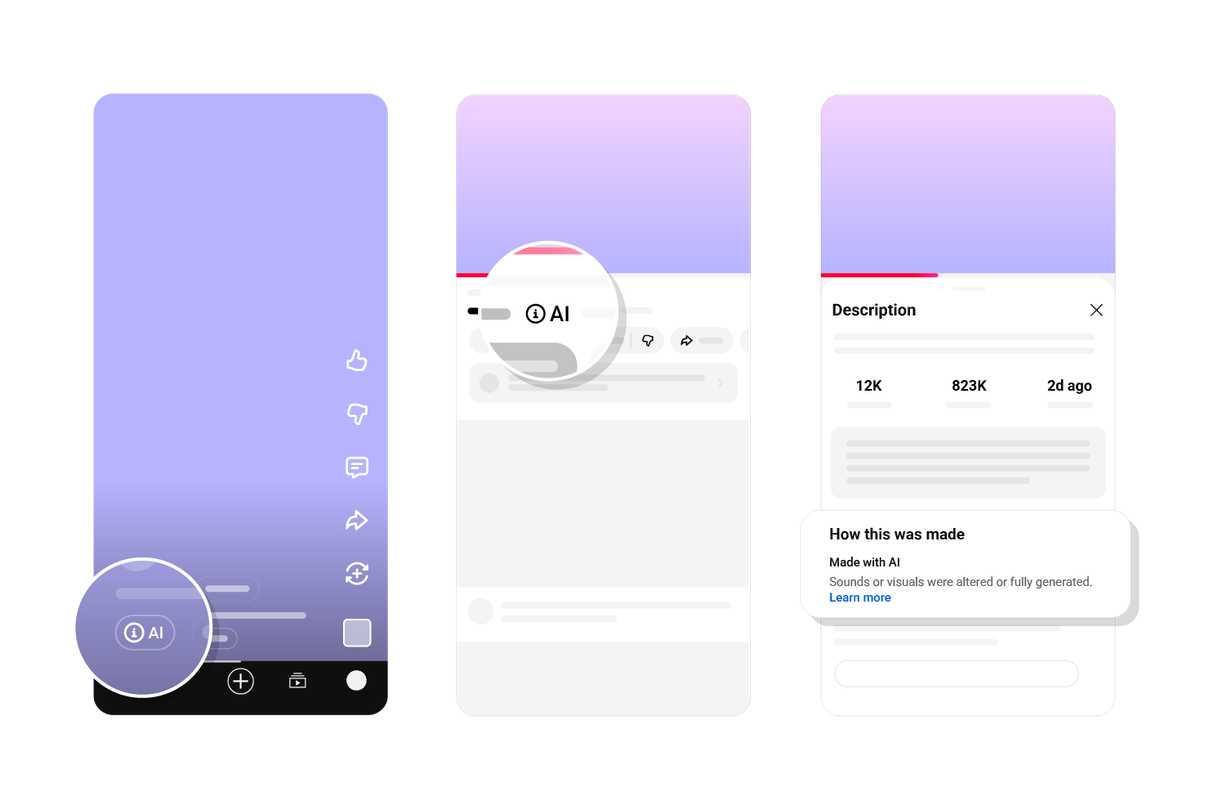
YouTube is officially moving past the ‘honor system’ for AI disclosures. Starting in May 2026, the platform will deploy internal signals to automatically detect and label photorealistic AI content that creators fail to disclose themselves.
This shift marks a significant escalation in how the world’s largest video platform manages the influx of synthetic media. For the last two years, AI labeling on YouTube was largely a manual task buried in the Creator Studio. Now, as models like Google’s own Veo and OpenAI’s Sora-class competitors reach photorealistic parity, YouTube is taking an active role in policing the ‘slop’ through automated enforcement and more aggressive UI placement.
The New Enforcement Mechanics
Until now, AI disclosures were tucked away in the expanded description box—a place most viewers never look. The new update moves these labels to the ‘main stage.’ On standard long-form videos, a clear ‘AI-generated’ label will sit directly under the player. On YouTube Shorts, the label will appear as a persistent overlay, ensuring viewers have context before the first loop finishes The Verge.
Technically, the ‘automatic’ part of this rollout relies on three distinct triggers:
- C2PA Metadata: If a video file contains metadata from the Coalition for Content Provenance and Authenticity (supported by OpenAI, Adobe, and Microsoft), the label is applied automatically and is permanent.
- First-Party Tooling: Anything created with YouTube’s internal generative tools, like Dream Screen or Veo, will be watermarked and labeled at the source.
- Internal Detection Signals: This is the ‘black box’ of the update. YouTube is using proprietary algorithms to scan for ‘significant photorealistic AI’ usage. If the system flags a video that the creator didn’t disclose, YouTube will apply the label on their behalf YouTube Blog.
The ‘Permanent’ Label Trap
One of the most critical details for practitioners is the lack of an ‘undo’ button for certain types of content. While creators can appeal labels generated by the general detection signals, they cannot remove labels if the content was made with YouTube’s own AI tools or if it carries C2PA metadata.
This creates a rigid environment for creators using high-end professional pipelines that bake in C2PA by default. If your workflow involves tools from ElevenLabs or OpenAI that support these standards, your content is now effectively ‘tagged’ in the eyes of the YouTube algorithm with no path to removal TechCrunch.
Community Sentiment and the ‘AI-on-AI’ Problem
The reaction from the creator community has been a mix of relief and technical skepticism. On Reddit, users in r/technology and r/PartneredYoutube have raised concerns about the inevitable ‘false positive’ loop. As one user noted, “You know they’re not paying people to do this, so they’re using AI to detect AI” Reddit.
There is a palpable fear that this will mirror the early days of ContentID, where legitimate creators were caught in automated crossfire. Early reports already suggest some creators are being ‘slapped’ with labels despite using traditional VFX or high-end practical lighting that the algorithm mistakes for synthetic generation Reddit.
Competitive Landscape: The Transparency Arms Race
YouTube isn’t acting in a vacuum. This move follows Google’s Gemini Omni release and mirrors similar efforts by Meta and TikTok. However, YouTube’s implementation is notably more aggressive because of its integration with the C2PA standard.
| Feature | YouTube (May 2026) | Meta / TikTok |
|---|---|---|
| Detection | Automatic via ‘Internal Signals’ | Mostly manual / metadata-based |
| Label Placement | Under player / Shorts overlay | Description / Small icon |
| C2PA Support | Permanent, non-removable | Varies by platform |
| Appeal Process | Available for algorithmic flags | Limited |
What This Means for Builders and Creators
If you are building AI video tools or managing a high-volume content channel, the ‘stealth AI’ era is effectively over on YouTube.
- Workflow Disclosure: If you use AI for ‘meaningful’ alterations (swapping faces, generating photorealistic backgrounds), disclose it early. If the algorithm catches you first, it may impact your standing with the platform’s trust systems, even if it doesn’t currently affect monetization.
- The ‘Uncanny Valley’ Tax: Content that looks ‘too perfect’ is now a liability. Creators using traditional CGI may find themselves fighting the automated labeling system more frequently.
- Metadata is Destiny: If your toolchain includes C2PA-compliant exports, understand that those labels are now permanent on YouTube. This is a win for transparency but a hurdle for creators who want their synthetic work to stand on its own merits.
Takeaways
- Automation is the new baseline: YouTube is no longer asking for honesty; it is enforcing it through algorithmic scanning.
- UI visibility has peaked: AI labels are moving from the ‘fine print’ of descriptions to the ‘front page’ of the video player.
- Monetization is safe (for now): YouTube explicitly stated that these labels do not currently affect ad revenue or recommendations, though this could change as ‘AI slop’ filters become a requested user feature.
- C2PA is the gold standard: If you want to avoid ‘false positive’ flags, using tools that correctly embed provenance metadata is the only way to ensure the label is accurate and undisputed.
Full analysis: {BLOG_URL}