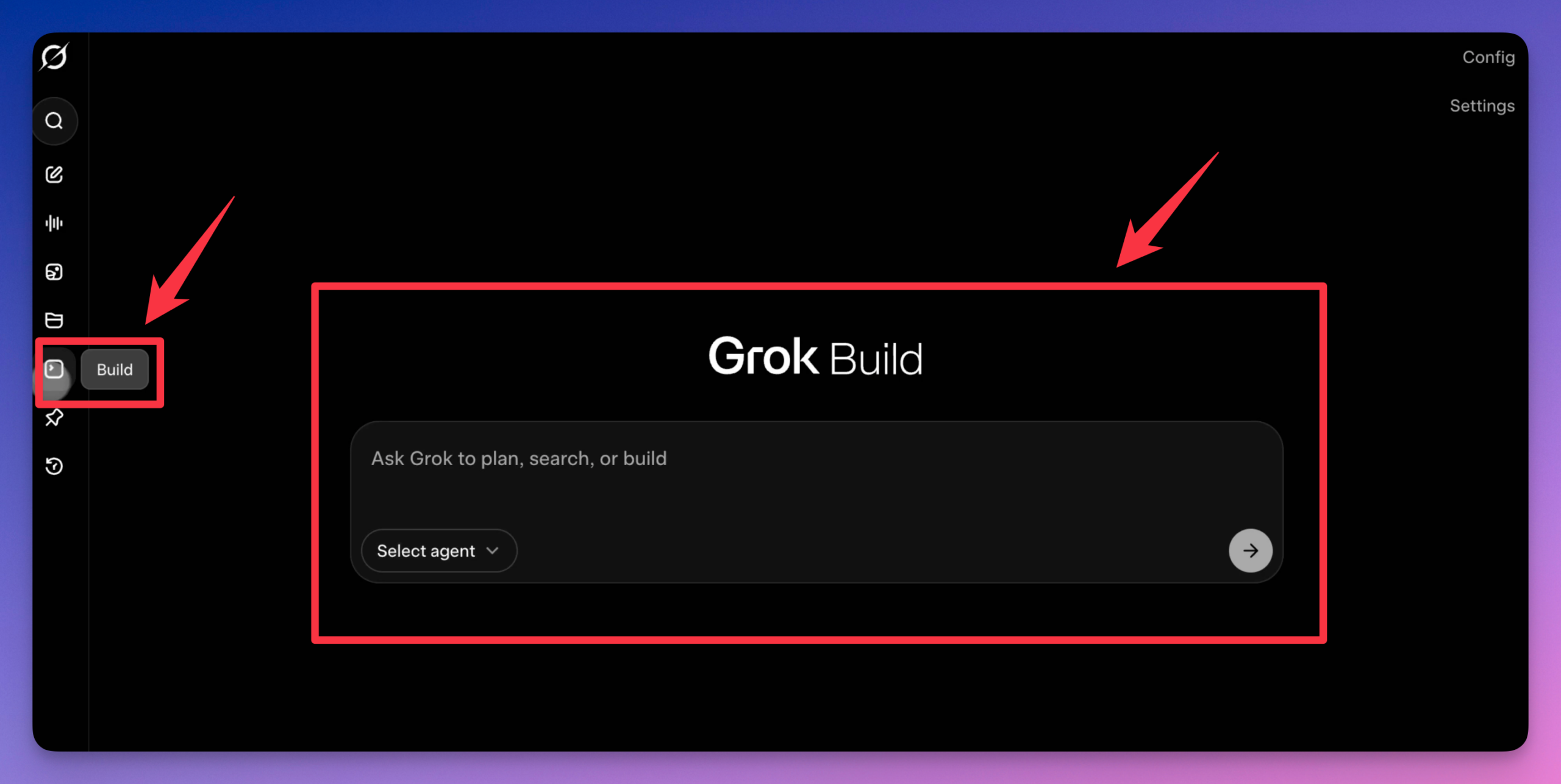
xAI has officially entered the autonomous coding race with the launch of Grok Build, a terminal-native agent designed to handle repository-wide engineering tasks. While the market is already crowded with tools like Cursor and Claude Code, xAI is betting on a high-concurrency, “plan-first” architecture that targets professional engineers working in large, complex codebases.
Currently in early beta, Grok Build is powered by the new Grok 4.3 model and is gated behind a premium SuperGrok Heavy subscription. Unlike simple autocomplete extensions, this is a full-blown CLI agent that can plan, execute, and debug code autonomously across multiple files. xAI News.
The Architecture: Parallel Subagents and Arena Mode
The standout technical feature of Grok Build is its orchestration layer. Rather than a single linear conversation, the tool can spawn up to 8 parallel subagents to tackle large-scale issues like system-wide regressions or massive refactors.
To prevent the “runaway agent” problem where an AI destroys a repository in a loop, Grok Build uses isolated Git worktree subagents. Each subagent runs in its own isolated environment, preventing race conditions or merge conflicts during the generation phase. Before any code is committed, the system utilizes an Arena Mode—an automated evaluation layer that scores and ranks competing outputs from different subagents, presenting the developer with the most viable solution. DevOps.com.
Technical Specifications
| Property | Specification |
|---|---|
| Core Engine | Grok 4.3 (Mixture-of-Experts) |
| Context Window | 2,000,000 tokens |
| Throughput | ~133 to 190 tokens per second |
| SWE-Bench Verified | 70.8% |
| Pricing (API) | $0.20/1M input, $1.50/1M output |
The 2-million-token context window is particularly notable, as it allows the agent to ingest massive documentation sets and deep dependency trees simultaneously without the need for aggressive RAG-based chunking that often loses context in complex logic. xAI News.
The “Plan-First” Workflow
For any task that isn’t a one-liner, Grok Build defaults to a structured planning phase. It generates a plan.md file in your project directory. As a developer, you can:
- Review the entire strategy before execution.
- Add comments to specific steps to steer the agent.
- Rewrite sections of the plan entirely.
Once approved, the agent executes the steps and generates clean Git diffs for review. This workflow is designed to mirror how senior engineers actually work: plan the architecture, then write the code. xAI News.
Ecosystem and Automation
Grok Build is built to be a “good citizen” in existing repositories. It natively reads AGENTS.md files and integrates with Model Context Protocol (MCP) servers, hooks, and custom plugins. For teams looking to automate their workflows, it includes a headless mode (-p) for CI/CD pipelines and full Agent Client Protocol (ACP) support for building custom internal bots. xAI News.
How to Try It
The beta is currently restricted to SuperGrok Heavy subscribers ($300/month). If you have an account, you can install the CLI via the following command:
curl -fsSL https://x.ai/cli/install.sh | bash
After installation, you can authenticate and start a session in any repository:
grok build
For automation or non-interactive tasks, use the headless flag:
grok build "Refactor the auth middleware to use JWT" -p
Competitive Landscape
Grok Build enters a market where Claude Code and Cursor are the current incumbents. While Cursor wins on “vibe coding” and fluid IDE integration, Grok Build is positioning itself as the heavy-duty terminal alternative.
Its SWE-Bench Verified score of 70.8% puts it within striking distance of Claude Sonnet 4 (72.7%), but at a significantly lower API price point ($0.20 per 1M input tokens vs. higher rates for competitors). However, the $300/month subscription for the CLI tool itself is a significant barrier for individual developers compared to the $20/month standard for Cursor or Copilot. DevOps.com.
Community Sentiment
Initial reactions from the developer community are polarized. On Reddit and Hacker News, practitioners have praised the TUI (built with Rust and Ratatui) for its speed and aesthetic, but the $300 price tag has been described by some as “DOA” for anyone not working at a well-funded enterprise.
Skeptics on Reddit have also flagged concerns regarding the reliability of the grok-code-fast-1 model, with some early testers reporting that it can be “very fast but very dumb” on complex logic, occasionally breaking existing code during refactors. Conversely, supporters on X are highlighting the local-first privacy model—where source code is not sent back to xAI servers—as a major win for corporate compliance. Sentiment Scan.
Takeaways
- Local-First Privacy: A major selling point for regulated industries; code stays on your machine.
- Massive Context: The 2M token window effectively eliminates the need for manual context management in large repos.
- High Barrier to Entry: The $300/month subscription makes this an enterprise-first tool for now.
- Parallelism is Key: The ability to run 8 subagents in isolated worktrees is a unique approach to scaling agentic work.
- Watch the Model: While fast, the
grok-code-fast-1model still needs to prove it can match the reasoning depth of Claude 4.x or GPT-4o in production environments.