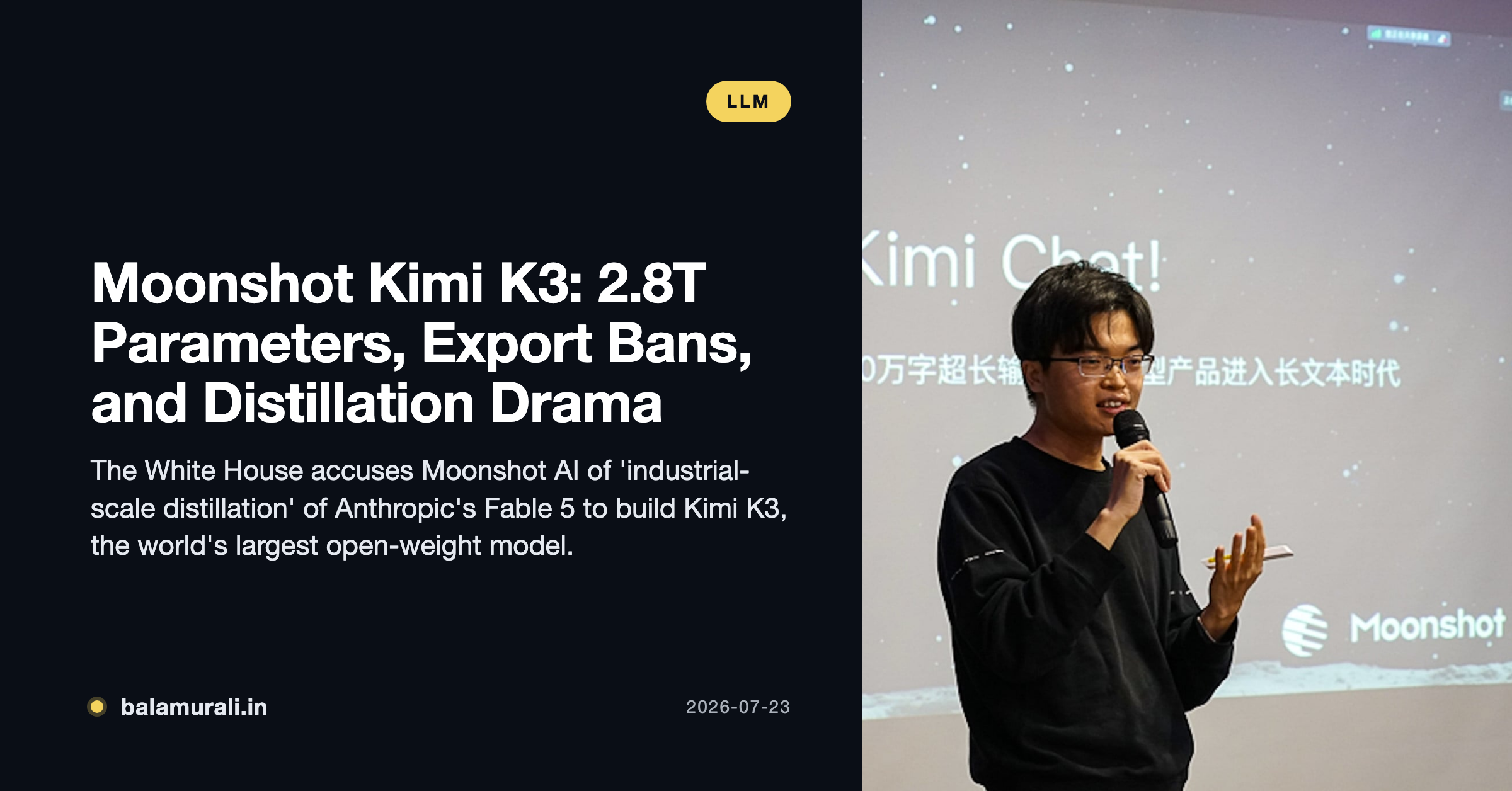
The White House has officially accused Chinese AI startup Moonshot AI of conducting “covert, industrial-scale distillation attacks” against Anthropic’s flagship Claude Fable 5 model to build its newly released Kimi K3. This escalation marks a new front in the AI arms race, where the line between legitimate model optimization and state-sponsored intellectual property theft has become a geopolitical flashpoint.
On July 22, 2026, Michael Kratsios, Director of the White House Office of Science and Technology Policy (OSTP), alleged that Moonshot engineered a sophisticated internal platform specifically designed to siphon data from US models while evading API rate limits Times of India. The stakes are high: Kimi K3 is a 2.8-trillion-parameter monster that currently claims the title of the largest open-weight model ever built, outperforming DeepSeek V4 Pro on several key reasoning benchmarks BenchLM.
The Concrete News: Sanctions and Servers
U.S. Treasury Secretary Scott Bessent has doubled down on these claims, stating that “Open source is not open season on American IP” and threatening Entity List designations for firms that cross the line into IP theft TechCrunch.
Beyond the data extraction, the White House claims Moonshot bypassed strict export controls by deploying banned Nvidia GB300 (Blackwell architecture) servers in Thailand to handle Kimi K3’s training. While the Trump administration eased some chip bans in late 2025, top-tier Blackwell chips remained strictly off-limits to Chinese entities. Moonshot reportedly utilized an “overseas loophole”—using subsidiaries in neutral Tier-2 countries—to access the compute necessary for a model of this scale Asia Times.
Technical Detail: Kimi K3 vs. Claude Fable 5
To understand why the US is concerned, look at the specs. Kimi K3 is a 2.8T parameter Mixture of Experts (MoE) model with roughly 50B active parameters per token. It features a 1.05M token context window and native multimodal vision support.
| Feature | Claude Fable 5 | Kimi K3 |
|---|---|---|
| Parameters | Undisclosed (Mythos-class) | 2.8 Trillion (MoE) |
| Context Window | 1,000,000 tokens | 1,050,000 tokens |
| Input Price | $10.00 / 1M tokens | $3.00 / 1M tokens |
| Output Price | $50.00 / 1M tokens | $9.00 / 1M tokens |
| Availability | Closed API / Bedrock | Open Weights (Planned) |
Kimi K3 isn’t just a cheap clone; it’s beating Western models on specific agentic tasks. On the Terminal-Bench 2.0 (Agentic Coding) benchmark, Kimi K3 scored 88.3%, significantly higher than DeepSeek V4 Pro’s 59.1% BenchLM. However, Fable 5 maintains a lead in 22 of 35 shared evaluations, particularly in vision and general knowledge Asia Times.
The “Impossible Timeline” Defense
Moonshot AI has directly denied the allegations, calling the idea that they built K3 from Fable 5 a physical impossibility. Claude Fable 5 was released on July 1, 2026, and Kimi K3 launched just 15 days later on July 16.
Experts at Kingy.ai agree that training a 2.8T parameter base model from scratch in two weeks is “extraordinarily unlikely.” They suggest a more nuanced reality: Moonshot likely used Fable 5 outputs for targeted post-training or fine-tuning to “polish” an already nearly finished model. Moonshot’s business head, Huang Zhenxin, points to their proprietary “Moon Clip” data-filtering engine, which they claim acts as a digital firewall to block synthetic content from third-party models Asia Times.
Competitive Landscape
This incident has intensified the debate over the “open-weight” movement coming out of China. If Moonshot can deliver Fable-level reasoning at 30% of the cost ($3/M tokens vs $10/M tokens), the business model of high-R&D US labs is under threat.
- DeepSeek V4 Pro: The previous open-weight king. It is faster and more cost-efficient but lacks Kimi’s native vision and deep reasoning logic.
- Anthropic Fable 5: The “teacher” in this scenario. It remains the gold standard for long-horizon autonomy and multi-stage projects spanning days Anthropic.
What People are Saying
The reaction from the practitioner community is split. On Reddit, many are skeptical of the White House’s timeline, noting that 15 days isn’t enough time to distill a base model, regardless of how many Blackwell chips you have in Thailand. However, on X, security-focused researchers are flagging the “sophisticated internal platform” allegation as a sign that industrial-scale scraping is becoming a standard part of the Chinese AI pipeline. The general sentiment is one of “geopolitical theater” meeting “technical reality,” with many operators simply happy to have a cheaper, high-performance alternative to Fable 5, regardless of its pedigree.
Takeaways
- Distillation is the new corporate espionage. The US government is signaling that using API outputs to train competing frontier models will be treated as IP theft, not just a Terms of Service violation.
- The “Overseas Loophole” is closing. Expect the Commerce Department to tighten rules on Chinese subsidiaries operating in Tier-2 countries like Thailand and Malaysia.
- Open-weight models are eroding the frontier moat. If a 2.8T model can be “polished” to Fable-level performance in weeks, the multi-billion dollar R&D lead of US labs is more fragile than it looks.
- Cost curves are collapsing. At $3/M input tokens, Kimi K3 makes high-reasoning agentic workflows viable for startups that couldn’t afford Anthropic’s Mythos-tier pricing.
Full analysis: {BLOG_URL}