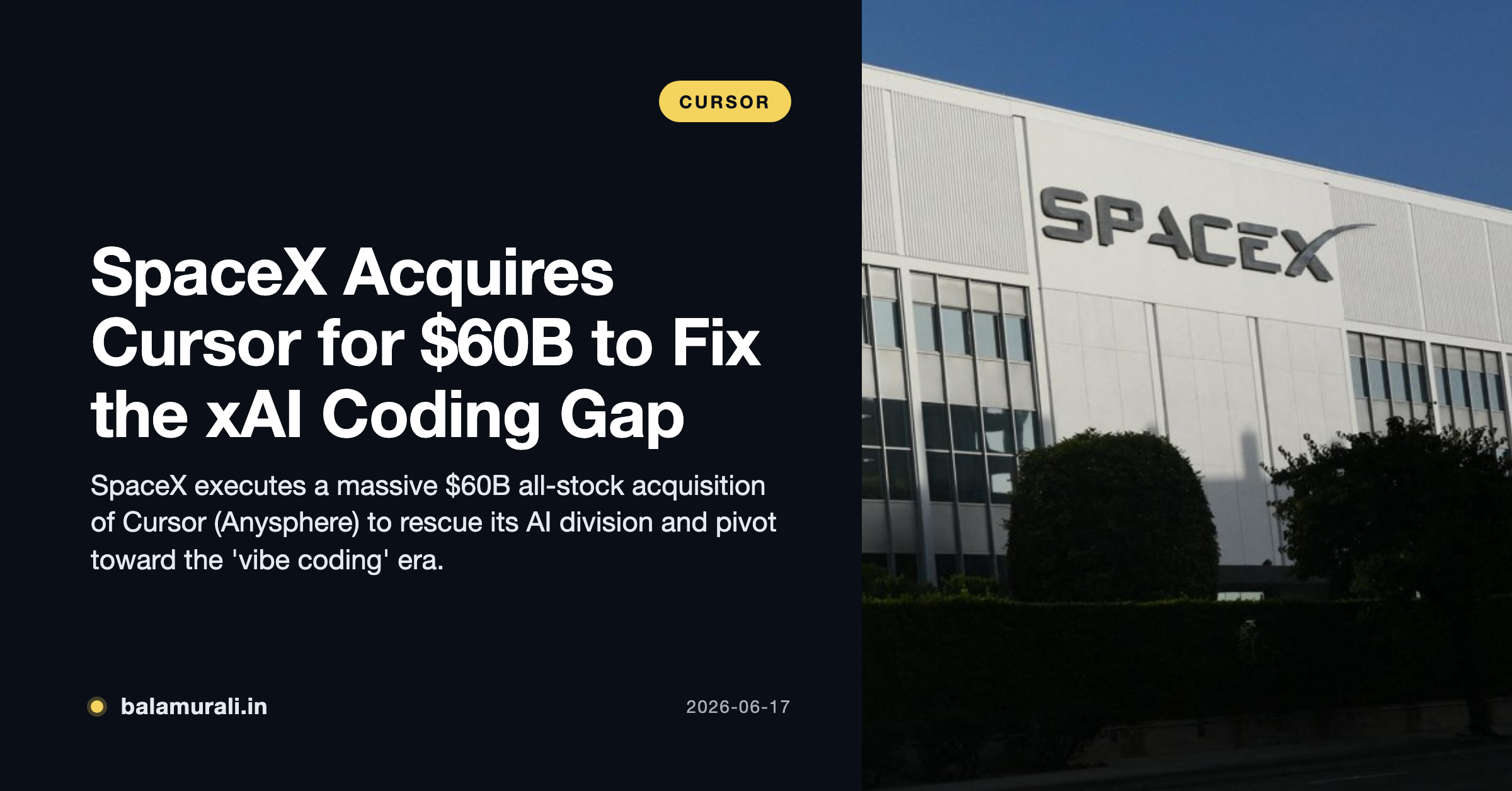
SpaceX has officially agreed to acquire AI coding startup Cursor (Anysphere) in a blockbuster $60 billion all-stock transaction. The deal, announced just days after SpaceX’s historic IPO, represents a massive strategic pivot to integrate high-velocity software development into the company’s expanding orbital compute ecosystem.
The Concrete News
This acquisition follows a highly unusual “buy or pay” agreement struck in April 2026, where SpaceX committed to either acquiring Cursor for $60 billion or paying a staggering $10 billion breakup fee The Verge. The deal is expected to close in Q3 2026. Prior to the SpaceX offer, Cursor was reportedly tracking toward a $2 billion private funding round at a $50 billion valuation, backed by heavyweights like Andreessen Horowitz, Thrive Capital, and Nvidia TechCrunch.
Technical Detail & Financial Reality
Despite Cursor’s meteoric rise—scaling from $100 million ARR in early 2025 to a projected $3 billion by mid-2026—the startup faced a brutal unit-economic reality. Research indicates that Cursor’s gross margins were sitting at negative 23% LinkedIn.
The core issue is the “Flat-Rate SaaS Deficit”: while users pay a predictable monthly fee ($20–$200), heavy power users executing multi-file context queries can consume up to $2,000 in API token costs per month. By merging with SpaceX, Cursor gains direct access to the “Colossus” supercomputer and the upcoming “AI1” satellite constellation, which aims to move AI compute into low-Earth orbit to bypass terrestrial power and cooling constraints Facebook/Bloomberg.
Competitive Landscape: The ‘Vibe Coding’ Shift
The acquisition is a direct response to the dominance of Anthropic’s Claude Code and OpenAI’s Codex. While GitHub Copilot maintains a 90% share of the Fortune 100, the market has shifted toward “vibe coding”—a paradigm where developers act as orchestrators of agentic workflows rather than syntax writers Fortune Business Insights.
SpaceX’s internal AI division, SpaceX AI (formerly xAI), has struggled with technical setbacks and content moderation scandals involving its Grok chatbot CNBC. By absorbing Cursor, SpaceX effectively replaces its underperforming native coding models with the industry’s favorite “agentic” IDE. The two teams have already been collaborating on “Grok Build,” a specialized model for engineering and knowledge work Ars Technica.
What People Are Saying
Community sentiment is a mix of awe at the valuation and skepticism regarding the cultural fit. On Reddit and X, practitioners have noted that Cursor was “bottlenecked on compute,” making the SpaceX infrastructure deal a logical, if expensive, escape hatch. However, some developers express concern that the “unfiltered” ethos of xAI might clash with the polished, enterprise-ready experience Cursor users expect.
Takeaways
- Compute is the new capital: Cursor’s negative margins prove that even $3B in revenue isn’t enough if you don’t own the underlying infrastructure.
- Vertical integration wins: SpaceX is building a full stack from the rocket to the IDE to the orbital silicon.
- Vibe coding is standard: The shift from autocomplete to agentic orchestration is now the primary battleground for enterprise AI.
- Consolidation is accelerating: Small, high-burn AI labs are being forced into the arms of infrastructure giants to survive the inference cost curve.