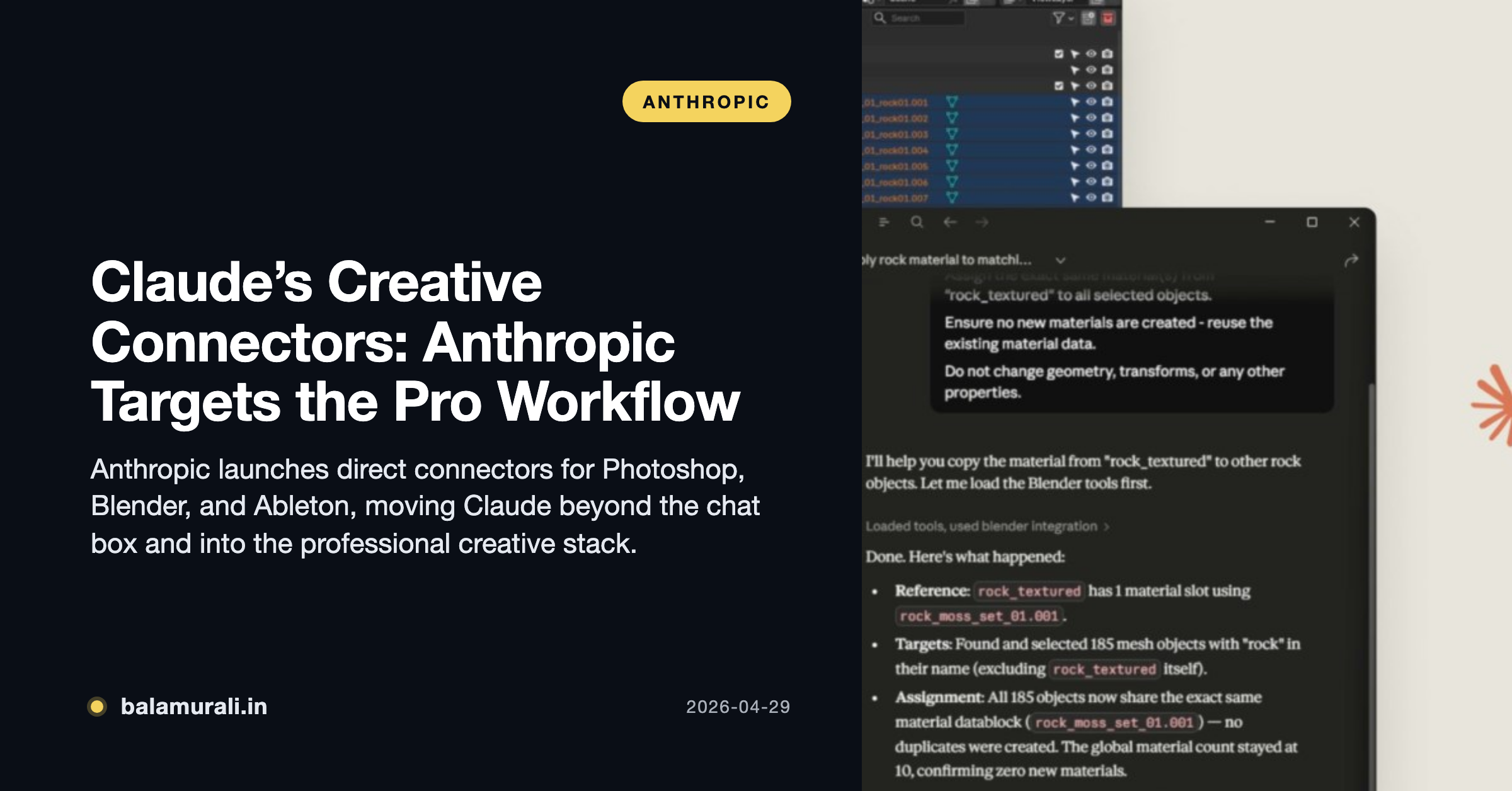
Anthropic is making a concerted push into the professional creative suite, moving Claude from a general-purpose assistant to a specialized co-pilot for high-end production. By launching a suite of “connectors” for industry-standard tools like Adobe Creative Cloud, Blender, and Ableton, the company is signaling that the next phase of LLM utility isn’t just about generating text, but about manipulating the specialized APIs of the software where professionals actually spend their time.
This release follows the recent launch of Claude Design and represents a shift in strategy. Rather than trying to replace the creative stack with generative “one-shot” tools, Anthropic is positioning Claude as a bridge between natural language and complex software interfaces. For practitioners, this means the ability to automate the “manual toil” of production without leaving the professional environment.
The Connector Ecosystem
The new connectors allow Claude to retrieve data, access documentation, and execute actions within specific third-party services. According to Anthropic’s official announcement, the initial partner list covers a broad spectrum of creative disciplines:
- Adobe Creative Cloud: Enables Claude to pull from over 50 tools, including Photoshop, Premiere, and Express, to assist in design and video workflows.
- Blender: Provides a natural-language interface to Blender’s Python API. This is particularly significant for technical artists who need to navigate complex 3D scenes or automate repetitive modeling tasks.
- Autodesk Fusion: Allows engineers and designers to create or modify 3D models through conversational prompts.
- Ableton: Grounds Claude’s responses in official documentation for Live and Push, effectively acting as an on-demand software tutor.
- Affinity by Canva: Focuses on production automation, such as batch layer renaming, image adjustments, and file exports.
- SketchUp: Converts descriptions of rooms or furniture into 3D starting points that can be opened directly in the app.
Technical Implications: API-First Creativity
For engineers and technical artists, the most interesting aspect of this release is the Blender integration. By exposing the Python API to Claude, Anthropic is essentially providing a high-level “compiler” for 3D operations. Instead of writing boilerplate scripts to manage scene hierarchies or material assignments, users can describe the desired state in natural language.
This approach acknowledges a fundamental truth in pro workflows: the “blank canvas” problem isn’t the only bottleneck. The real friction often lies in the “middle-mile” of production—the hundreds of small, repetitive clicks required to move a project from a rough concept to a polished deliverable. By automating these via the Python API, Claude becomes a tool for managing complexity rather than just generating pixels.
Supporting the Open Source Foundation
In a move that has garnered significant goodwill in the creative community, Anthropic has also become a Corporate Patron of the Blender Development Fund. The company has committed at least €240,000 (approximately $281,000) annually to support the open-source 3D suite.
This puts Anthropic in the same league as other major industry sponsors like Netflix, Epic Games, and Wacom. For a company often criticized for the “black box” nature of its models, this financial commitment to open-source infrastructure is a strategic play to win over the developer and artist communities who are often skeptical of AI’s role in their craft.
Competitive Landscape
Anthropic is entering a crowded field. Adobe has its own Firefly ecosystem deeply integrated into Creative Cloud, and OpenAI has been teasing similar “agentic” capabilities for some time. However, Anthropic’s approach with Claude seems focused on high-fidelity grounding. By using official documentation (as seen with the Ableton and Blender integrations), they are attempting to solve the hallucination problem that plagues creative professionals who need precise, actionable technical advice.
Where Adobe’s Firefly is often seen as a tool for “generating content,” Claude’s connectors are being framed as a tool for “operating software.” This distinction is subtle but critical for practitioners who don’t want the AI to do the work for them, but rather to help them navigate the tools they already use.
What People are Saying
The reaction from the technical community has been cautiously optimistic. On platforms like Hacker News and Reddit, users are highlighting the potential for these connectors to lower the barrier to entry for complex software like Blender or Fusion 360. However, there are lingering questions about latency and the depth of the integrations.
Some practitioners note that while a “natural language interface to a Python API” sounds great on paper, the real test will be how Claude handles edge cases in complex project files. The sentiment is that if these connectors can reliably handle the “boring” parts of the job—renaming 500 layers or setting up a standard lighting rig—they will become indispensable.
Takeaways for Practitioners
- Automation over Generation: Focus on using these connectors to eliminate “manual toil” (batch exports, renaming, API scripting) rather than just asking for creative ideas.
- The Tutor in the Machine: The Ableton and Blender integrations are particularly strong for onboarding team members to new software or mastering obscure features without leaving the app.
- API Literacy Matters: The Blender connector relies on the Python API; understanding the underlying structure of the software will still help you prompt Claude more effectively.
- Watch the Integration Depth: Not all connectors are created equal. Some (like Ableton) are documentation-focused, while others (like Affinity) are action-focused. Evaluate each based on your specific bottleneck.
- Open Source Alignment: Anthropic’s support of Blender suggests they are betting on open-source tools remaining a core part of the professional pipeline.
Full analysis: {BLOG_URL}