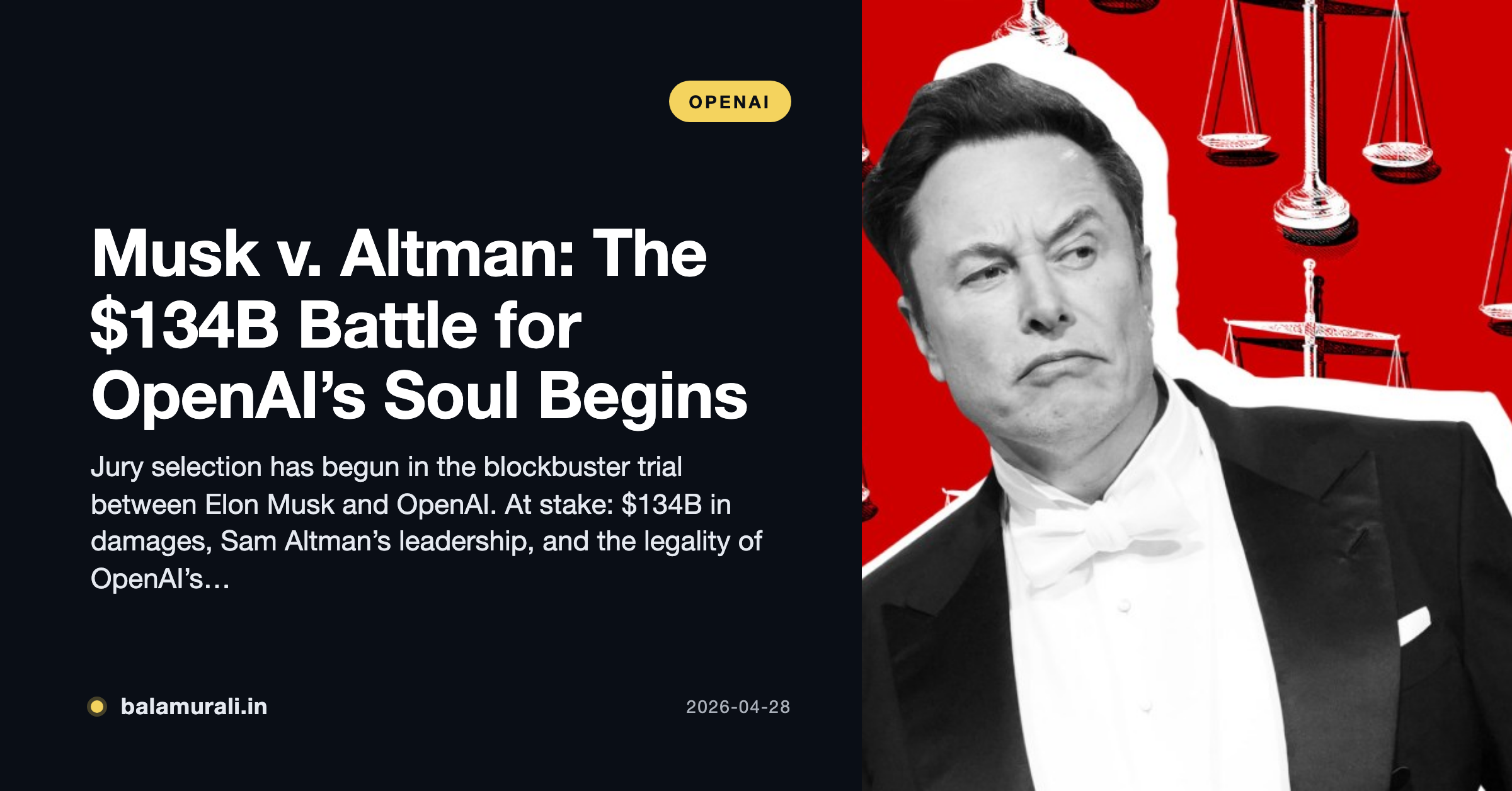
The most expensive grudge match in Silicon Valley history has finally reached the courtroom. On April 27, 2026, jury selection began in Oakland, California, for Musk v. Altman, a trial that seeks to determine whether OpenAI’s transition from a scrappy nonprofit to a $157 billion powerhouse was a masterstroke of scaling or a historic breach of charitable trust.
Elon Musk is suing OpenAI, CEO Sam Altman, and President Greg Brockman, alleging they “flipped the narrative” after securing his early funding and technical endorsement. Musk’s legal team argues that the founding agreement—to develop Artificial General Intelligence (AGI) for the benefit of humanity rather than private profit—was effectively shredded when OpenAI partnered with Microsoft and restructured its corporate DNA. OpenAI, meanwhile, dismisses the suit as a “baseless and jealous bid” to derail a competitor while Musk’s own xAI races to catch up.
The Legal Stakes: Damages and Leadership
This isn’t just a war of words; the numbers involved are staggering. Musk is seeking between $134 billion and $150 billion in damages The Guardian. In a move designed to maintain the moral high ground, Musk has specified that any winnings would be funneled back into OpenAI’s nonprofit arm rather than his own pockets.
Beyond the cash, the lawsuit seeks “nuclear” remedies:
- Leadership Removal: The removal of Sam Altman and Greg Brockman from their executive roles and board seats.
- Structural Reversal: An order to unwind the recent corporate restructuring and return OpenAI to its original nonprofit-only status.
- Microsoft Oversight: A declaration that OpenAI has become a “de facto subsidiary” of Microsoft, potentially jeopardizing the licensing deals that power Azure’s AI services.
The “Public Benefit” Pivot
To understand the trial, you have to understand the restructuring OpenAI completed in October 2025. After 18 months of negotiations with the Attorneys General of California and Delaware, OpenAI transitioned its for-profit subsidiary into a Public Benefit Corporation (PBC) DeepLearning.ai.
Under the current 2026 structure:
- OpenAI Foundation: The original nonprofit holds a 26% equity stake (valued at roughly $130B) and retains the power to appoint the PBC’s board.
- Microsoft: Holds a 27% stake.
- The PBC: Legally required to balance shareholder returns with its mission to ensure AGI benefits humanity.
Judge Yvonne Gonzalez Rogers, who is presiding over the case, has already made a significant pre-trial ruling. On April 24, 2026, she approved a request to drop fraud and constructive fraud claims from the suit CNBC. This streamlines the trial to focus on breach of charitable trust and unjust enrichment. Notably, the nine-person jury will only provide an advisory verdict on liability; the judge retains the final authority to decide both the verdict and the remedies.
Competitive Context: The xAI Factor
It is impossible to view this trial in a vacuum. While Musk’s lawyers argue about nonprofit ethics, his business empire is moving in the opposite direction. In early 2026, Musk merged xAI with SpaceX, creating a conglomerate valued at up to $1.5 trillion [Deep Research]. This entity is currently preparing for a massive IPO in June 2026, aiming to raise $75 billion to fund “orbital data centers.”
OpenAI’s defense leans heavily on this: they argue Musk is using the court to handicap a rival. They point to Musk’s own 2017 emails suggesting a for-profit pivot was necessary and his reported $97.4 billion “sham bid” to take over OpenAI in early 2025 as evidence that his concerns aren’t about the mission, but about who controls it.
What to Expect in the Courtroom
The trial is expected to last four weeks, wrapping up around May 21, 2026. The witness list is a “who’s who” of the AI boom, including:
- Sam Altman and Greg Brockman: Defending their pivot to the PBC model.
- Ilya Sutskever and Mira Murati: Former insiders whose testimony could reveal the internal friction during the 2023 board coup.
- Satya Nadella: Expected to testify on the nature of the Microsoft partnership.
During jury selection, the atmosphere was reportedly tense. Several prospective jurors expressed negative views of Musk, with one calling him a “jerk” and another citing his political involvement The Verge. Judge Gonzalez Rogers acknowledged the sentiment, dryly noting, “The reality is that people don’t like him,” but insisted the jury could remain impartial.
Takeaways for Practitioners
- Governance is Code: For founders, the OpenAI saga proves that early-stage governance docs are not just paperwork—they are potential $100B liabilities. If you start as a nonprofit or a PBC, the path to a traditional exit is paved with regulatory landmines.
- The AGI Definition Matters: Much of the legal battle hinges on when “AGI” is achieved. Once a model is deemed AGI, Microsoft’s commercial rights to the tech typically expire. Expect the trial to feature heated debates over whether GPT-5 or Grok 5 meet this threshold.
- Capital Warfare: The SpaceX-xAI merger and OpenAI’s PBC conversion show that the “compute moat” now costs billions per month. The legal structures are simply vessels to attract the massive capital required for the next generation of clusters.
- Discovery Risks: The trial will likely unearth internal communications (Slack, Signal, emails) from the 2015-2018 era. For the rest of us, it’s a reminder that today’s “private” venting is tomorrow’s Exhibit A.
Full analysis: {BLOG_URL}